
Ask three aunties what happens at a Hindu wedding and you will get three slightly different answers. That is the honest truth about Indian weddings: there is a shared backbone of rituals, and every family, community and pandit adds its own chapters to it. What follows is the order we see most often at the weddings we photograph in and around Indore. Treat it as a map, not a rulebook.
Knowing the flow matters for more than curiosity. When you know what happens when, you can plan your day, brief your family, and actually enjoy your own wedding instead of asking someone what comes next every hour.
In the days before the wedding
For many families, the ceremonies begin a few days before the wedding itself. The exact mix depends on your family and community, but these are the ones you will most often see in Madhya Pradesh:
- Ganesh puja. Many families begin wedding celebrations with a small puja at home, asking for the days ahead to go smoothly. Some families do it on the morning of the wedding instead.
- Haldi. Family members apply a turmeric paste to the bride and groom, usually at their own homes and most often in the morning. It is playful, messy and full of colour – our haldi photography guide shows how to keep the moments beautiful without the chaos.
- Mehendi. The bride’s mehendi usually happens a day or two before the wedding and often turns into an evening of music with the women of the family. Our mehendi ceremony photography notes cover what photographs beautifully here.
- Sangeet or cocktail evening. Many families add a music evening somewhere in these days – sometimes a traditional sangeet, sometimes a modern cocktail night.
The wedding morning
The wedding day itself often begins early, with preparations in both homes. Depending on the family, the morning can include a chooda and kaleera ceremony for the bride, sehra bandi for the groom, or a simple family puja before anyone leaves home. These are some of the most emotional, unguarded moments of the whole wedding, and they are worth leaving unhurried time for.
Baraat, welcome and varmala
The groom’s side arrives as the baraat – dancing, music and all – and the bride’s family welcomes them at the entrance. Many families follow this with milni, where the two families greet each other, before the couple meets on stage for the varmala, the exchange of garlands. The baraat has its own rhythm and photo opportunities; we wrote about them in our baraat photography notes.
The main ceremony at the mandap
This is the heart of a Hindu wedding. Families and pandits adapt the details, but the core sequence usually includes:
- Ganesh puja at the mandap, blessing the ceremony that is about to begin.
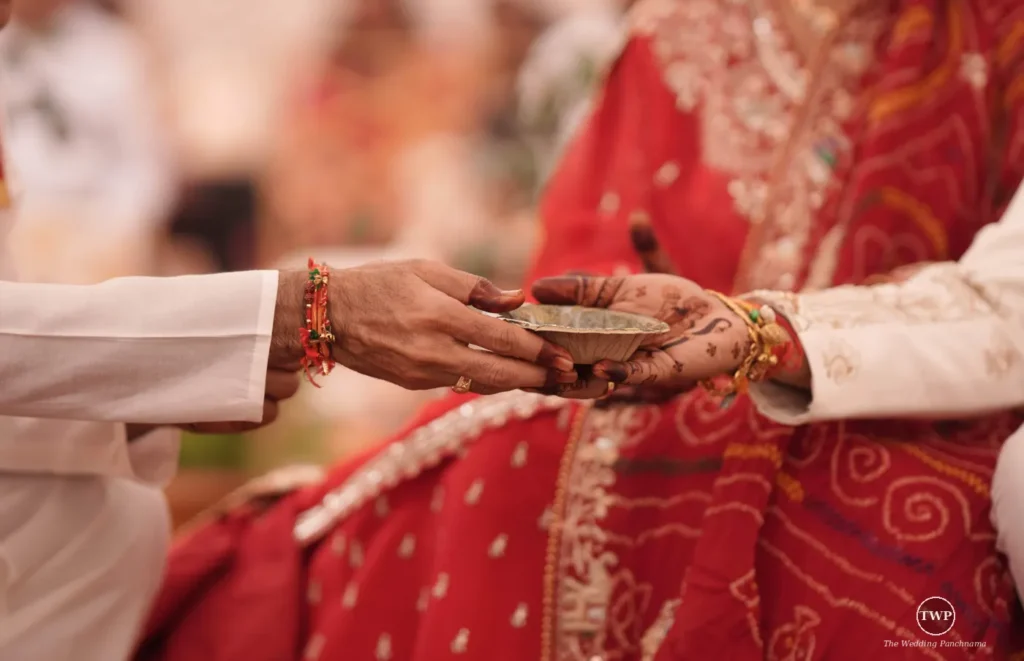
- Kanyadaan, where the bride’s parents place her hand in the groom’s – a quiet, weighty moment amid the celebration.
- Gathbandhan, the tying of the knot between the couple’s garments.
- Mangal pheras and saptapadi. The couple circles the sacred fire, and with the seven steps they make their vows to each other. For many families this is the moment the marriage is complete.
- Sindoor and mangalsutra, which the groom then offers the bride.
- Ashirwad, as elders bless the couple and guests line up to congratulate them.
After the pheras
The celebration usually continues with dinner and photographs with guests. The emotional close comes with the vidaai, when the bride says goodbye to her family home – a moment every parent feels, and one we handle gently as photographers (see our vidaai photography notes). Many families then welcome the bride into her new home with a griha pravesh ceremony, and quite a few in Indore hold the reception on a separate evening altogether.
Why the order matters for your photographs
Once you know your family’s version of this flow, share it with your photography team. Which rituals will your family include? Roughly when will the pheras begin? An honest timeline is the difference between a photographer who is always in position and one who is always catching up. Our wedding photography timeline guide shows how to build that plan around the rituals that matter to you.
Every wedding we photograph in Indore follows its own version of this map. The rituals change, the order shifts, and that is exactly what makes each wedding worth remembering.
Photo: The Wedding Panchnama.